
The Central Financial institution of Egypt (CBE) has mentioned the persistence of the Iran-US battle continues to weigh on the worldwide and home economies, with lingering results on financial exercise, international funding, and home inflation.
The CBE added in its lately issued Financial Coverage Report (MPR) that current beneficial macroeconomic developments, attributed to the non permanent ceasefire settlement and better-than-expected inflation outturns, led it to barely revise its baseline inflation forecast downward within the brief time period.
Accordingly, the Financial Coverage Committee (MPC) determined at its Could and July 2026 conferences to maintain key coverage charges unchanged, sustaining an adequately tight financial coverage stance to anchor inflation expectations and assist the disinflation path in the direction of its goal degree by the second half (H2) of 2027.
World scenario
Globally, development amongst Egypt’s buying and selling companions slowed barely to a mean of two.2% within the second quarter (Q2) of 2026, down from 2.3% in Q1, as spillovers from the Iran-US battle weighed on financial exercise.
Import-weighted inflation amongst Egypt’s buying and selling companions accelerated from a mean of three.9% in Q1 2026 to 4.5% in Q2, amid persistent exterior value pressures and renewed geopolitical tensions.
In the meantime, international commodity costs remained excessive regardless of a brief softening in June, whereas international monetary circumstances stabilised as capital flows and sovereign spreads improved in the course of the de-escalation interval.
However, the appreciation of the US greenback and the resurgence of geopolitical tensions in the direction of the tip of the quarter renewed dangers surrounding international inflation, commodity markets, and exterior monetary circumstances.
Annual headline inflation
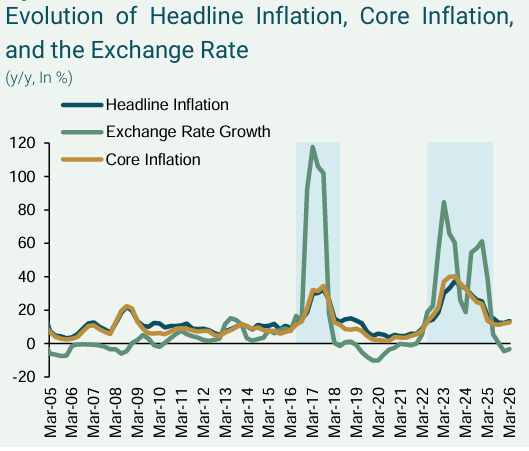
Domestically, annual headline inflation rose to a mean of 14.6% in Q2 2026, up from 13.5% in Q1, reflecting non permanent home seasonal components, changes to regulated power and transportation costs, in addition to the pass-through of world shocks and regional geopolitical developments.
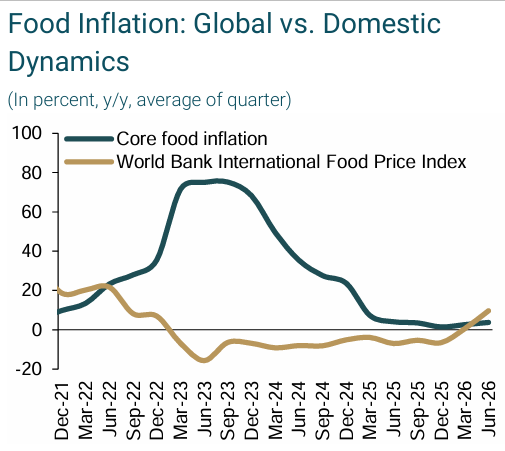
Annual meals inflation rose to six.6% in Q2 2026, in contrast with 4.1% within the earlier quarter, whereas annual non-food inflation remained broadly secure at 19.7%, reflecting the comparatively persistent nature of inflation throughout non-food items, significantly providers.
However, quarterly developments (y-o-y) masks the constructive month-to-month inflation dynamics all through Q2 2026, mirrored within the diffusion index declining to its lowest studying since mid-2025, registering 9.4% in June 2026.
Actual GDP development
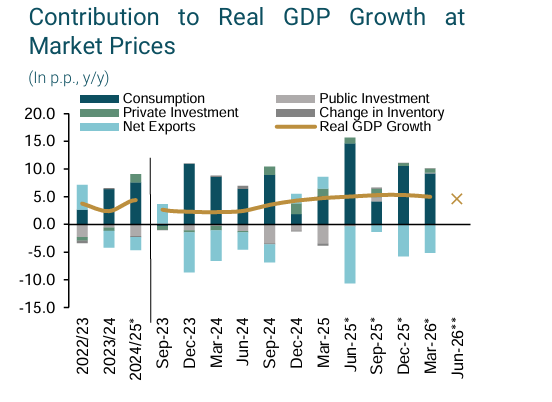
The CBE now casts actual GDP development in Q2 2026 at roughly 4.5%, primarily pushed by non-petroleum manufacturing, communications, and commerce actions.
Relating to precise developments, actual GDP development at market costs recorded 5% in Q1 2026, in contrast with 4.8% in Q1 2025, signalling strong development in financial exercise, primarily pushed by consumption and personal funding.
With respect to the labour market, the unemployment price declined to six.0% in Q1 2026, in opposition to 6.3% within the corresponding quarter of 2025, whereas actual wage development decelerated notably to 1.3% in Q1 2026, down from 11% a yr earlier, resulting from slower nominal wage development and an uptick in inflation.
Egypt’s exterior place
Egypt’s exterior place remained resilient in Q1 2026 in opposition to the repercussions of the regional battle, with the steadiness of funds recording a marginal surplus of $0.3bn.
On the one hand, the present account deficit greater than doubled in contrast with Q1 2025 to face at $5.1bn, equal to 1.2% of GDP. This was pushed by a bigger commerce deficit and a decline within the internet funding revenue steadiness, which had been partially offset by greater remittances and receipts from tourism and the Suez Canal.
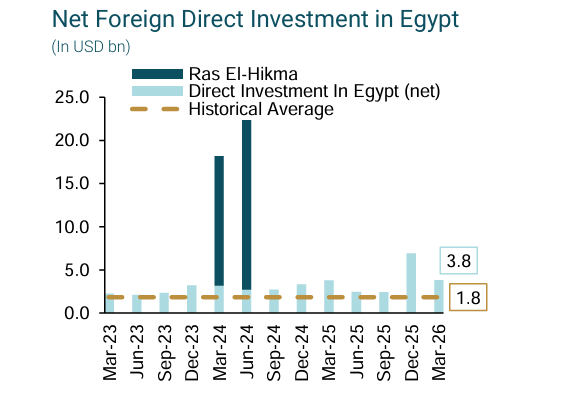
However, the capital and monetary account recorded a internet influx of $3.4bn in Q1 2026, supported by FDI inflows, medium- and long-term mortgage disbursements, and a drawdown of business banks’ international property following appreciable internet portfolio outflows triggered by the outbreak of the regional battle.
Web worldwide reserves
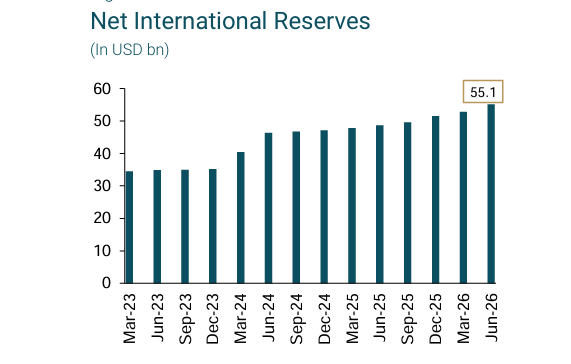
Nonetheless, throughout Q2 2026, following the easing of regional tensions and the gradual restoration in investor sentiment, internet worldwide reserves elevated to $55.1bn in June 2026, in contrast with $52.8bn in March 2026.
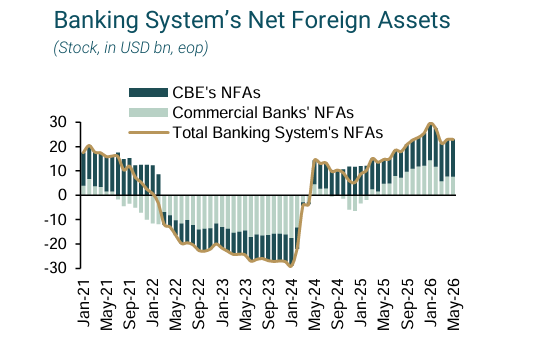
This was additionally in keeping with the partial rebound within the banking system’s internet international property (NFAs) throughout Q2 2026, which reached $22.9bn in Could 2026, up from $21.4bn in March, primarily pushed by industrial banks’ NFAs.
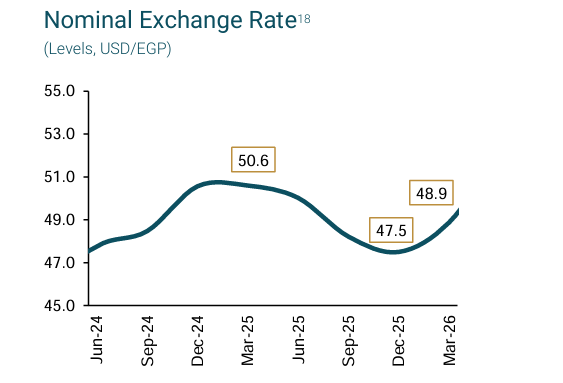
This was additionally mirrored within the notable appreciation of the pound from EGP 54.6 to EGP 49.2 per USD between March and June 2026.
Monetary circumstances and home credit score
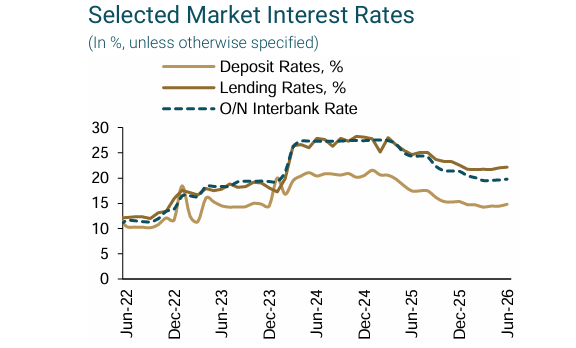
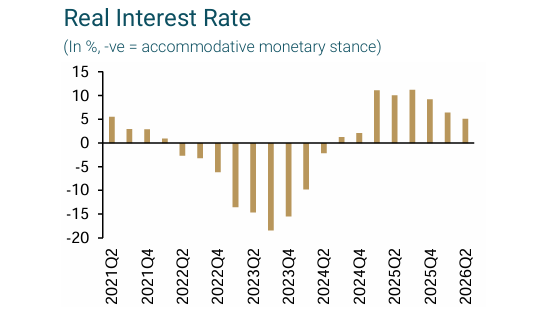
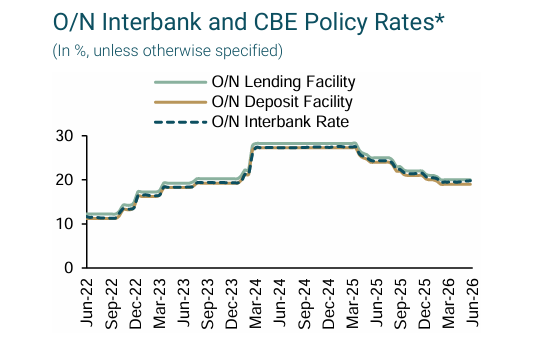
With respect to monetary circumstances and home credit score, tighter liquidity circumstances pushed the in a single day interbank price barely above the coverage price, averaging 19.8% in June 2026, in contrast with 19.5% in March 2026.
Nonetheless, it remained intently aligned with the coverage price, with roughly 93% of the coverage price cuts since April 2025 transmitted to the in a single day interbank price.
Equally, round 75% of the decline within the in a single day interbank price since April 2025 handed by to common new deposit and lending charges by June 2026, indicating financial coverage transmission to the cash market and monetary circumstances.
In the meantime, actual development in local-currency (L/C) loans to the non-public sector registered a mean of seven.3% in Q2 2026, supported by the continued provision of L/C loans to the non-public enterprise sector, significantly within the industrial and providers sectors.
Egyptian Eurobond
Egyptian Eurobond yields additionally declined by a mean of 110 foundation factors throughout all tenors in Q2 2026, reflecting improved investor threat sentiment as regional tensions eased by the tip of the quarter.
CBE inflation projections
Given the better-than-expected home financial developments, CBE inflation projections have been revised barely downward within the close to time period, with common annual headline inflation nonetheless anticipated to quickly speed up in Q3 2026, partly resulting from unfavourable base results, albeit at a extra average tempo than beforehand projected.
Thereafter, inflation is predicted to steadily decline and attain single digits throughout H2 2027, aligning with the focused degree of seven% (±2%), supported by the prevailing tight financial stance over the forecast horizon.
However, the inflation outlook stays prone to dangers, as mirrored in two various situations: escalation and de-escalation. As such, annual headline inflation is predicted to vary between 15.2-17.8% and seven.7-8.3% on common in FYs 2026/27 and 2027/28, respectively, below completely different battle situations, in contrast with a mean of 13.3% in FY 2025/26.
CBE barely revises actual GDP development forecast
With respect to output, the CBE barely revised its actual GDP development forecasts to five% and 4.9% for FYs 2025/26 and 2026/27, respectively, up by 0.1% for every fiscal yr in contrast with the Q1 2026 MPR, whereas FY 2027/28 is projected to develop by 5.4% on common.
The upward revision for FYs 2025/26 and 2026/27 primarily displays a stronger projected contribution from the Suez Canal than assumed within the earlier MPR.
Moreover, development forecasts for FYs 2026/27 and 2027/28 proceed to be primarily pushed by the manufacturing and providers sectors, significantly tourism, with FY 2027/28 additionally supported by the projected normalisation of the financial coverage stance.
Nonetheless, estimates point out that output stays under potential, although gradual convergence is predicted by H1 2027, suggesting that demand-side inflationary pressures are projected to stay restricted within the brief time period, supported by the presently tight financial coverage stance.