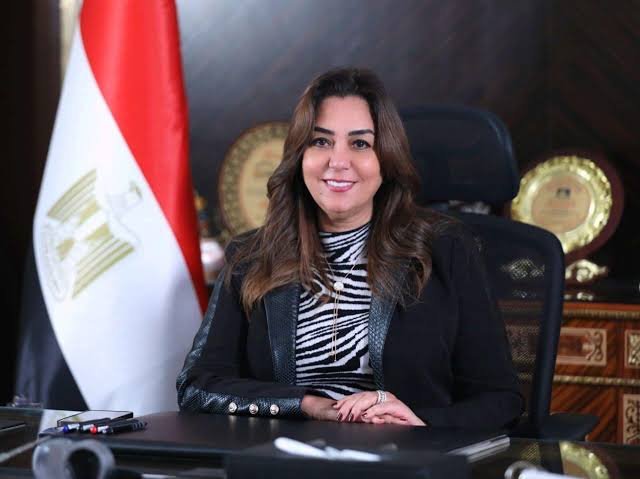

Dr. Manal Awad, Minister of Local Development and Environment, announced the details of the procedures for obtaining public store licenses through the “Digital Egypt” portal, within the framework of the state’s plan to expand the provision of government services electronically, and to simplify licensing procedures in accordance with the provisions of the Public Stores Law.
The Minister said, during a press conference at the Ministry’s headquarters in the New Administrative Capital, that the procedures for obtaining the license begin by entering the “Digital Egypt” portal or going to the technology center in the local unit or the city agency, then submitting the required documents and paying the inspection fees, so that a temporary permit is issued until the competent authorities finish the inspection work and fulfill the requirements, before paying the license fees and issuing the final license.
She added that the basic documents include a copy of the national ID card, and the ownership or lease contract with a date stamp, along with completing the rest of the documents, including the commercial registry extract, the tax card, and a sketch showing the location and area of the store, in addition to the health certificate for workers in food activities.
She explained that the license applicant obtains a temporary permit for a period of three months until the licensing procedures are completed, and in the event that there is no response from the competent authorities during that period, the approval is considered implicitly issued, with the continued commitment to obtaining approvals for the activities that require this, first and foremost the civil protection requirements.
She pointed out that the inspection fees do not exceed one thousand pounds, while the licensing fees range between one thousand pounds and 100 thousand pounds, depending on the type of activity, the area of the shop, and the geographical location, in addition to the fees prescribed for the competent authorities, such as Civil Protection, the Food Safety Authority, and the Environmental Affairs Agency, in accordance with the regulating legislation.
For his part, Representative Mohamed Attia Al-Fayoumi, the official spokesman for the Supreme Committee for Public Store Licensing, confirmed that the Public Stores Law does not aim to collect additional fees from citizens, but rather aims to regulate commercial activities and facilitate licensing procedures.
Al-Fayoumi said that some citizens have inaccurate concepts regarding the philosophy of the law, calling on the Ministry of Local Development to implement an integrated media plan through the media and social media platforms to clarify the objectives of the law and the mechanisms for its implementation.
He added that the law is based on legal controls aimed at regulating commercial activities, simplifying licensing procedures, and achieving discipline in markets, in the interest of citizens and public shop owners.