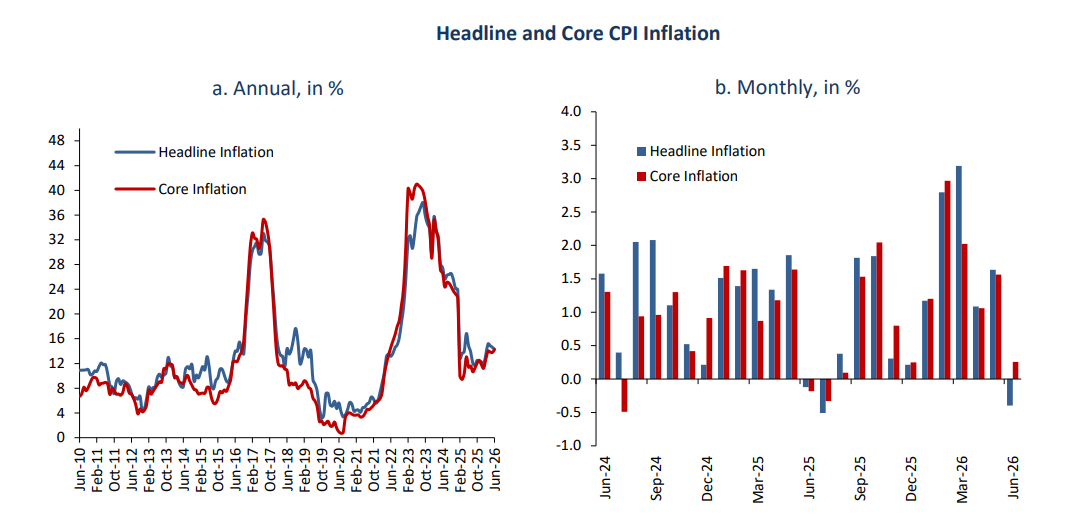

Egypt’s annual city headline inflation eased to 14.3% in June 2026, down from 14.6% in Might, as a pointy slowdown in meals inflation offset continued will increase in non-food costs, in accordance with the Central Financial institution of Egypt (CBE).
The CBE stated the moderation was primarily pushed by annual meals inflation, which slowed to five.4% in June from 7.6% in Might, reversing the earlier seasonal enhance in each core and risky meals inflation. In the meantime, annual non-food inflation edged greater, primarily reflecting continued value will increase within the providers sector.
On a month-to-month foundation, city headline inflation recorded -0.4% in June, in contrast with -0.1% in June 2025 and 1.6% in Might 2026.
The month-to-month decline was largely pushed by decrease meals costs, with each risky and core meals inflation falling nicely under their historic averages. The lower mirrored decrease costs for poultry, eggs and contemporary greens, which greater than offset greater non-food inflation ensuing from rising rents and seasonal will increase in Hajj and Umrah prices.
Annual core inflation rose barely to 14.3% in June from 13.8% in Might, primarily on account of an unfavourable base impact.
Month-to-month core inflation slowed to 0.3% in June, in contrast with -0.2% in June 2025 and 1.6% in Might 2026. The CBE stated providers remained the principle contributor to month-to-month core inflation, outweighing the decline in core meals costs.
Annual rural headline inflation additionally eased, falling to 10.1% in June from 11.4% in Might. Consequently, annual nationwide headline inflation, which mixes city and rural inflation, decelerated to 12.2% from 13.0% over the identical interval.
Meals costs drive month-to-month decline
The CBE stated month-to-month meals inflation fell by 3.2% in June, subtracting 1.19% from month-to-month headline inflation.
Unstable meals costs declined by 8.7%, contributing -0.61%, largely reflecting a seasonal correction in vegetable costs, which dropped 14.2%, whereas contemporary fruit costs rose modestly by 1.3%, broadly in step with historic seasonal patterns.
Core meals costs fell by 2.1%, subtracting 0.58% from month-to-month inflation and recording their steepest month-to-month decline since Might 2024. Not like risky meals objects, the CBE stated this decline deviated from regular seasonal patterns and was primarily pushed by sharp value falls in poultry (-12.5%) and eggs (-10.3%).
Against this, month-to-month non-food inflation rose 1.3%, contributing 0.79% to headline inflation.
Companies costs elevated 2.1%, accounting for 0.62% of month-to-month inflation. The rise mirrored greater rents following the continued pass-through of earlier changes to the Previous Lease Legislation, alongside seasonal will increase in Hajj and Umrah prices and better spending on eating places and cafés.
Retail costs rose 1.1%, contributing 0.15%, pushed by will increase in family cleansing merchandise, clothes and footwear, and private care merchandise.
Inflation for regulated objects recorded 0.1% throughout the month, contributing 0.03%.
The CBE added that month-to-month core inflation of 0.3% mirrored these developments, with providers contributing 0.86%, retail objects 0.21%, whereas core meals costs decreased core inflation by 0.81%.
Meals disinflation moderates annual inflation
Annual meals inflation slowed to five.4% in June from 7.6% in Might, contributing 2.09% to annual headline inflation.
Unstable meals inflation eased to 16.9% from 25.8%, contributing 1.07%, reflecting continued deflation in contemporary fruit costs and slower will increase in vegetable costs in contrast with June 2025.
Annual core meals inflation additionally moderated to three.4% from 4.4%, contributing 1.03%, largely on account of decrease poultry and egg costs in contrast with the identical month final yr.
In the meantime, annual non-food inflation accelerated to 19.9% in June from 19.1% in Might, contributing 12.21% to annual headline inflation.
Companies inflation remained the biggest contributor, rising to 27.5% and accounting for 7.50% of annual inflation, pushed by greater rents, Hajj and Umrah prices, and spending on eating places and cafés.
Annual inflation for regulated objects stood at 13.7%, contributing 2.95%, primarily reflecting greater tobacco costs and public transport fares.
Retail inflation reached 12.1%, contributing 1.76%, supported by annual will increase in clothes, private care merchandise, family cleansing merchandise and car costs.
Annual core inflation reached 14.3% in June, with providers contributing 10.39%, retail objects 2.45%, and core meals 1.42%, reflecting the continued resilience of underlying inflationary pressures regardless of the moderation in meals costs.